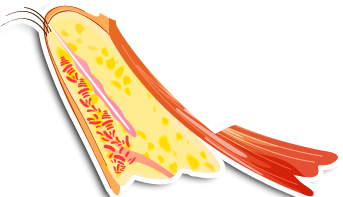
The upper eyelid and lower eyelid help protect the eye from debris, excessive light, and injury. They also spread the tear film evenly across the eye surface with each blink, keeping it lubricated.(1)
Conjunctiva
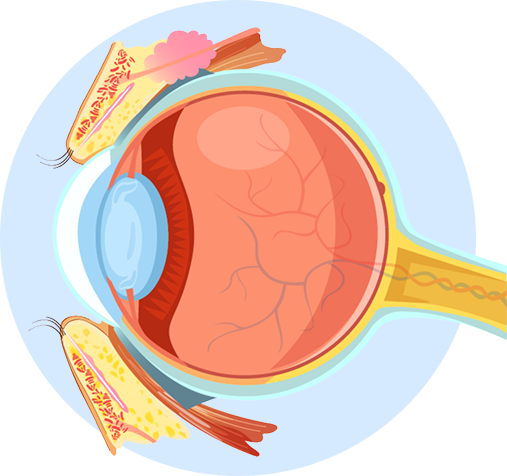
The conjunctiva is a clear membrane that covers the sclera (the white of the eye)(1) and lines the inside of the eyelids. It helps keep the eye moist and protects it from dust and microorganisms.
Aqueous
humor
The aqueous humor is a clear fluid found in the front part of the eye, between the cornea and the lens.(1) It provides nutrients to the eye and helps maintain intraocular pressure, ensuring the eye retains its shape.
Cornea
At the very front of the eye is the cornea, a clear, dome-shaped surface that covers the iris and pupil. The cornea helps focus incoming light onto the retina, playing a crucial role in vision. It is covered by the tear film, a thin layer of moisture that keeps the eye surface smooth and hydrated.(1)(2)
Tear film
The tear film is a thin, protective layer covering the eye’s surface.(1) Composed of oil, water, and mucus, it keeps the eye hydrated, smooth, and clear while protecting it from irritants and infections.
Located behind the iris and pupil, the lens is a clear structure that further focuses light onto the retina. It changes shape to help us see objects clearly at different distances.(2)
Upper and lower eyelids
The upper eyelid and lower eyelid help protect the eye from debris, excessive light, and injury. They also spread the tear film evenly across the eye surface with each blink, keeping it lubricated.(1)
Vitreous body
The vitreous body is a gel-like substance that fills the large space between the lens and the retina.(2) It helps maintain the eye’s shape (to keep the eye round) and allows light to pass through to the retina without obstruction.(1)
Fovea
The fovea is a small central area in the retina responsible for sharp, detailed central vision. It contains a high concentration of cone cells, enabling clear focus and color perception.(3)
Retina
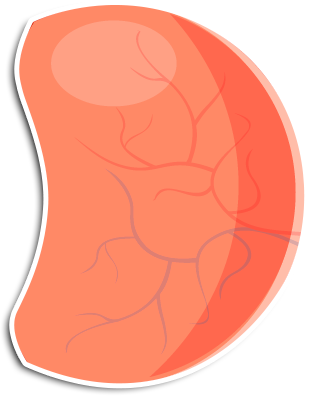
The retina is a thin layer of tissue lining the back of the eye. It contains light-sensitive cells that detect light and convert it into electrical signals.
These signals are then sent to the brain via the optic nerve, allowing us to see.(1)
The central part of the retina is the fovea, a small depression responsible for sharp central vision.(3)